Food & Wine · Pairing Guide
How to Pair Cypriot Wine with Food: From Halloumi to Kleftiko
Cypriot wine and Cypriot food grew up together over several thousand years. Here’s what that history figured out and how to use it at your table.
By CWFexpo Editorial12 min readUpdated May 2026Part of our Cypriot Wine series
The best wine and food pairings are rarely the result of theory. They are the result of the same people eating the same food with the same wine over a very long time, and gradually arriving at combinations that make both taste better than they would alone. Cypriot wine and Cypriot food have had approximately five thousand years to work this out between them. The combinations they’ve arrived at are worth paying attention to.
This guide is not about rules. There are no rules in food and wine pairing only principles, and the best principle is this: if it grew on the same island, in the same soil, under the same sun, it probably works. The rest is detail.
What follows is the detail.
The one rule worth keeping
Cypriot wine and Cypriot food are a natural match because they evolved together. Xynisteri’s acidity was built by the same climate that makes halloumi salty. Maratheftiko’s tannins developed alongside the lamb dishes of the mountain villages. Commandaria’s sweetness has been a counterpoint to Cypriot desserts for centuries. When in doubt, think geographically rather than technically.
The Pairing Principle: Geography First, Theory Second
Wine and food pairing has accumulated a significant body of received wisdom over the years, white wine with fish, red wine with meat, sweet wine with dessert. Most of it is useful as a starting point and limiting as a destination. The more interesting question is not “what are the rules?” but “why do some combinations work so much better than others?”
The honest answer is contrast and complement. Acidity in wine cuts through fat and salt in food, refreshing the palate for the next bite. Tannin in red wine reacts with protein in meat, softening both. Sweetness in wine amplifies and extends flavour in food, particularly when combined with something savoury or bitter. These reactions happen at a chemical level, but you don’t need to understand the chemistry to experience the result, you just need to pay attention to what happens in your mouth.
Xynisteri’s acidity was built by the same climate that makes halloumi salty. These things belong together. You don’t need a textbook to tell you that.
— CWFexpo Wine Guide, 2026
With Cypriot wine, the geography does most of the work for you. The island’s food traditions, heavy on salt, olive oil, char, herbs, and slow-cooked protein, were developed in the same conditions that produced the wine. Xynisteri’s defining acidity and minerality is exactly what you need alongside the salt and squeaking fat of grilled halloumi. Maratheftiko’s firm tannin is the structural counterpart to the richness of kleftiko slow-cooked lamb. Commandaria’s sweetness and complexity is the natural companion to the honey and nut pastries of the Cypriot table.
The principles below apply this geographical logic to specific pairings, with enough detail to be useful and enough flexibility to encourage experimentation.
01
Match acidity to salt and fat
An acidic wine refreshes the palate between bites of salty or fatty food. This is why Xynisteri and halloumi work: the wine’s acidity cuts through the cheese’s salt and fat, making the next bite of halloumi taste better than the last. Apply this principle wherever you encounter salty Cypriot food, olives, cured meats, seafood and reach for a crisp, high-acid white.
02
Match tannin to protein
Tannin and protein react in the mouth, softening each other. A tannic red wine like Maratheftiko, which can feel harsh on its own, becomes smooth and generous alongside lamb, beef, or aged cheese. This is why young tannic reds almost always improve with food, and why drinking them without food can be an austere experience.
03
Match sweetness to sweetness — or contrast it with salt
Sweet wine and sweet food can work, but the wine needs to be sweeter than the food or it will taste thin and sharp by comparison. Commandaria is sweet enough to handle most Cypriot desserts. Alternatively, deploy its sweetness as a contrast, against salty aged cheese, savoury pâté, or a sharp blue, and the combination becomes more interesting than either element alone.
04
Match weight to weight
A delicate wine disappears alongside a rich dish. A heavy wine overwhelms a delicate one. Promara with light seafood. Yiannoudi with pork. Maratheftiko with lamb. The principle here is proportion: the wine and the food should be in roughly the same weight class, so neither is extinguished by the other.
Xynisteri Pairings
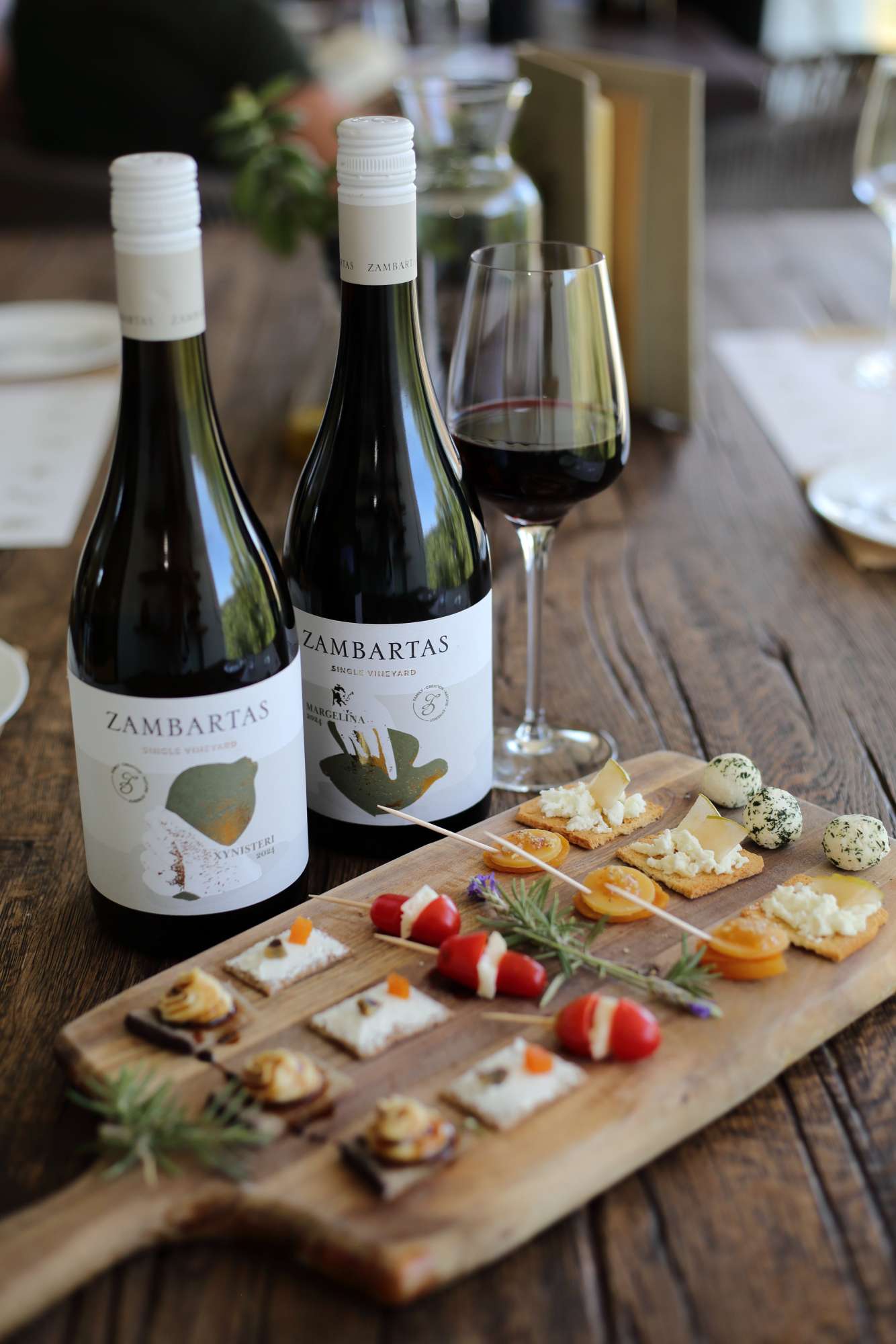
Xynisteri is the most versatile white wine in the Cypriot repertoire and, in good vintages from altitude producers, one of the most food-friendly white wines you’ll find anywhere in the Mediterranean. Its defining characteristics crisp acidity, mineral salinity, restrained alcohol make it a natural partner for the salt-forward, olive-oil-rich, herb-fragrant food of the Cypriot table.

Xynisteri
Dry White · Crisp · Mineral · 11.5–13% ABV
Halloumi
The classic pairing
The single most natural pairing in Cypriot wine. Xynisteri’s acidity cuts through halloumi’s saltiness and the milky fat of the cheese, refreshing the palate between bites. Serve the wine well-chilled and the halloumi straight from the griddle — the contrast of temperature adds another dimension to a pairing that is already remarkably good. Grilled halloumi works better than fried, as the char adds a slight bitterness that the wine’s minerality echoes.
Grilled Fish
Sea bass, bream, red mullet
Fish grilled over charcoal with lemon, olive oil, and dried herbs is as Cypriot as it gets, and Xynisteri is the natural choice alongside it. The wine’s citrus and saline notes echo the lemon and the sea; its acidity lifts the natural sweetness of the fish. High-altitude Xynisteri from producers like Kyperounda is particularly well-suited, as the extra mineral depth complements the smoky char from the grill.
Seafood Mezze
Calamari, prawns, octopus
The mezze table — particularly a seafood mezze — is Xynisteri’s natural home. The wine’s versatility across different flavour profiles means it moves between the salt of calamari, the sweetness of prawns, and the slight earthiness of octopus without losing its footing at any point. Serve it in a carafe rather than individual glasses so it stays at the right temperature as you work through the spread.
Talatouri
Cypriot yoghurt dip
The Cypriot version of tzatziki — thick yoghurt with cucumber, mint, and garlic — has a creamy richness that Xynisteri handles with ease. The wine’s freshness prevents the pairing from becoming heavy, and its slight floral quality picks up the mint in the dip in a way that is genuinely elegant.
Kolokotes
Pumpkin & bulgur pastry
These traditional Cypriot pastries — filled with pumpkin, bulgur wheat, raisins, and cinnamon — have a sweet-savoury balance that benefits from the crisp acidity of a well-made Xynisteri. The wine doesn’t fight the sweetness; it frames it, keeping the palate fresh across multiple bites of something that could otherwise feel heavy.
Maratheftiko and Red Wine Pairings
The indigenous Cypriot reds, Maratheftiko, Yiannoudi, and blends of the two, are built for food. Their tannins, which can seem formidable when tasted alone, become generous and integrating alongside the protein-rich, slow-cooked dishes of the Cypriot table. The rule with Cypriot reds is simple: always eat with them.
Maratheftiko & Cypriot Reds
Dry Red · Full Body · Age-worthy · 13–14.5% ABV
Kleftiko
The defining pairing
Slow-roasted lamb sealed in a clay pot with lemon, garlic, bay, and oregano — cooked for hours until the meat falls from the bone. Maratheftiko alongside it is as close to a canonical pairing as Cypriot wine produces. The wine’s firm tannin reacts with the protein in the lamb, softening both; its dark fruit and earthy depth mirrors the intensity of the slow-cooked meat; and its natural acidity — present even in this full-bodied red — cuts through the fat to keep each bite and each sip feeling fresh. Decant the wine for at least an hour before serving. Open it when the kleftiko goes in the oven.
Souvla
Whole meat on the spit
The social centrepiece of Cypriot cooking — large cuts of pork, lamb, or chicken rotated slowly over charcoal for several hours. The char, the smoke, the rendered fat, and the crisp exterior all call for a wine with structure and presence. Maratheftiko or a serious Yiannoudi both deliver. A lighter Mavro-based red, served slightly cooler, works well for pork souvla where a lighter touch is more appropriate.
Stifado
Braised meat with onions & spice
The Cypriot stifado — typically rabbit or beef braised with shallots, cinnamon, cloves, and red wine — has a deep, complex sweetness that benefits from a wine with matching depth. Maratheftiko’s earthy dark fruit and the spice notes of a well-aged Yiannoudi both work here. The cinnamon in the stew often echoes the spice notes in the wine in a way that feels entirely intentional, even if it wasn’t.
Aged Kefalotyri
Hard Cypriot cheese
Kefalotyri — a hard, salty, sheep’s milk cheese aged until sharp and crumbly — is one of the most underrated cheese pairings in the Mediterranean tradition. Its intensity demands a wine with structure, and Maratheftiko has exactly that. The tannin softens against the protein and fat of the cheese; the wine’s dark fruit becomes sweeter in contrast to the cheese’s saltiness. A small wedge with a glass of Maratheftiko is a combination worth seeking out.
Loukaniko
Cypriot spiced sausage
Loukaniko — pork sausage cured with red wine, coriander seed, and sometimes Commandaria — is the kind of dish that makes a good red wine taste significantly better than it would alongside something blander. The coriander and spice in the sausage echo the herbal notes in a Maratheftiko or Yiannoudi. The fat needs the tannin. The salt needs the acidity. Everything about this pairing makes structural sense.
Commandaria Pairings
Commandaria is more versatile at the table than its reputation as a pure dessert wine suggests. Its combination of high sweetness and high natural acidity means it handles flavours that would overwhelm a lighter wine, particularly the contrast between sweet and salty that recurs throughout Cypriot cuisine. The traditional Cypriot habit of serving Commandaria at the end of a meal, with something sweet, is correct. But it is not the only option.

Commandaria
Sweet Amber · Full Body · 15–16% ABV · The World's Oldest Named Wine
Baklava
The traditional ending
Filo pastry, crushed nuts, and honey — the pairing is so natural it has been made on this island for centuries. The wine’s acidity cuts through the honey and pastry; its dried fruit and spice notes echo the cinnamon and clove in the baklava. The sweetness of both elements amplifies the pleasure of each without overwhelming the palate. Serve the baklava at room temperature rather than warm — the cooler temperature prevents the honey from becoming cloying and allows the Commandaria to take its proper place alongside it.
Loukoumades
Honey doughnuts
Honey-fried dough fritters, served warm with honey and cinnamon. The contrast between the crisp, hot exterior and the cool, rich wine is one of the most pleasurable sensory contrasts in Cypriot food. The wine’s warmth from alcohol meets the warmth of the loukoumades; its acidity prevents the sweetness from becoming overwhelming. Add a pinch of sesame on the loukoumades and you add another layer of texture that works beautifully against the wine’s richness.
Aged Hard Cheese
Kefalotyri, mature Cheddar, Manchego
The sweet-salty pairing is one of the most reliable in gastronomy, and Commandaria and aged cheese is one of its best expressions. The saltiness of the cheese amplifies the sweetness of the wine; the wine’s acidity cuts through the fat; and the dried fruit notes of the Commandaria complement the nutty, crystalline character of a well-aged hard cheese. A small amount of both is the right amount — this is not a combination to rush.
Dark Chocolate
70% cocoa or above
The bitterness of good dark chocolate and the sweetness of Commandaria create a tension that makes both more interesting. The tannin in the chocolate and the residual sugar in the wine interact in a similar way to the tannin-protein interaction in red wine and meat — softening each other, finding a middle ground that is more pleasurable than either element alone. Use a chocolate with at least 70% cocoa content; below that, the chocolate becomes too sweet and the pairing loses its dynamic tension.
Blue Cheese
Roquefort, Stilton, Gorgonzola
A more adventurous pairing, and one that rewards the willingness to try it. The pungent, savoury intensity of a good blue cheese is offset by Commandaria’s sweetness in the same way that Sauternes works with Roquefort — the contrast of flavour categories creates a combined effect that is far greater than the sum of its parts. Serve the cheese at room temperature so its flavour is fully developed. Serve the Commandaria slightly cooler — around 12°C — so the sweetness stays fresh rather than heavy.
As an Aperitif
With almonds, dried fruits, olives
Commandaria served slightly cool before a meal — with a small plate of roasted almonds, dried figs, and good olives — works as an aperitif in a way that surprises most people encountering it for the first time. The combination of sweet wine with salty snacks is appetite-awakening rather than appetite-killing, provided the portions are modest. This is how Commandaria was sometimes served in the medieval tradition of the Knights Hospitaller, and it is a practice that deserves revival.
Cypriot Rosé Pairings
Cypriot rosé has improved dramatically over the past decade. The best examples, dry, pale, and made from indigenous red varieties, are far removed from the sweet pink wines that damaged the category’s reputation in the 1980s and 1990s. A serious Cypriot rosé brings enough acidity and structure to handle food properly, while its lighter body makes it more versatile across a spread of dishes than either a white or a red wine.

Cypriot Rosé
Dry · Medium Body · Versatile · 12–13.5% ABV
Mezze
The all-purpose answer
A dry Cypriot rosé at the mezze table is the answer to the question of which single wine to drink through an entire Cypriot spread. It has enough acidity for the dips and salads; enough body for the grilled meats and halloumi; and enough freshness to survive the evening without becoming tiresome. If you are sitting down to a large shared meal and want one wine that will work across the table, this is the answer.
Souvlaki
Pork or chicken on skewers
Pork souvlaki — the most everyday expression of Cypriot cooking — is a natural rosé dish. The char from the grill, the herbs from the marinade, and the slight sweetness of the pork all work alongside a dry rosé without requiring the structural weight of a red. Serve it in summer, in a garden, slightly cooler than you think necessary.
Sheftalia
Cypriot lamb & pork sausage
These traditional Cypriot sausages — minced pork and lamb wrapped in caul fat and grilled — have a richness and an herbal quality that suits a rosé with some body and persistence. The fat needs the acidity; the herbs are echoed in the wine’s own aromatic character. Sheftalia with good rosé is one of the most satisfying simple combinations in Cypriot eating.
A Complete Cypriot Wine and Food Menu
Here is a full menu from aperitif through dessert pairing each course with the appropriate Cypriot wine. Use it for a dinner party, a special occasion, or as a guide when you are planning which wines to bring home from CWF Expo.
A Cypriot Evening Menu
Wine pairings for a full meal from aperitif to dessert
Aperitif
Commandaria with almonds, dried figs & olives
Commandaria — served slightly cool, in small glasses
Mezze
Talatouri, hummus, olives, kolokotes, grilled halloumi
Xynisteri — high altitude, well-chilled
Fish Course
Charcoal-grilled sea bream with lemon & herbs
Xynisteri or Promara — the lighter and more mineral, the better
Main
Kleftiko — slow-roasted lamb with garlic & oregano
Maratheftiko — decanted one hour, served at 16–17°C
Cheese
Aged kefalotyri, dried figs, walnuts
Maratheftiko continued, or an aged Commandaria
Dessert
Baklava or loukoumades with honey & cinnamon
Commandaria — served at 12°C, generous pour
Pairing at CWF Expo: A Different Kind of Tasting
The food and wine pairing experience at CWF Expo is unlike anything you will encounter in a restaurant or at a formal tasting. The wine and the food exist in the same building, produced and served by the same community, consumed at the same time by thousands of people who have been combining them for most of their lives.
The Cypriot Food Hall at CWFexpo sits alongside the Wine Hall. You can take a glass of Xynisteri from one stand and walk it directly to a halloumi vendor ten metres away. You can try a Maratheftiko alongside a kleftiko that has been cooking since the morning. You can finish with a Commandaria and a loukoumades from the far end of the hall. The pairings in this guide are not theoretical for CWFexpo visitors, they are what actually happens, repeatedly, over two days every June.
If you want to understand what Cypriot wine tastes like with Cypriot food, there is no better environment in the UK to find out. The 2026 event takes place on Saturday 6th and Sunday 7th June at The Decorium, London N22.
CWFexpo · June 6 & 7, 2026 · The Decorium, London
Every pairing in this guide — under one roof.
Wine from 20+ Cypriot producers. Authentic Cypriot food from the community’s best vendors. The combinations this guide describes, available to taste in real time. Saturday 6th & Sunday 7th June 2026, London N22.
Frequently Asked Questions
Xynisteri is the definitive answer. The grape’s high natural acidity cuts through halloumi’s salt and fat, refreshing the palate between bites in a way that makes each mouthful of cheese taste better than the last. A dry Cypriot rosé is an equally good alternative — slightly more weight, the same quality of acidity. Both are indigenous to the same island as the cheese, which is rarely a coincidence when it comes to pairing.
The convention against red wine with fish is largely based on the reaction between iron compounds in red wine tannins and the oils in fish, which can produce a metallic, unpleasant aftertaste. This is particularly pronounced with oily fish like mackerel or sardines and with heavily tannic reds. In practice, a lighter-bodied Cypriot red with low tannin — a well-made Mavro or a lighter Yiannoudi — works fine with char-grilled fish, particularly if the fish has been cooked over charcoal. The char provides enough structure to meet the wine partway.
Mezze is designed to be eaten slowly, across many small dishes with different flavour profiles — which makes a single wine pairing surprisingly difficult to get right. The practical answer is a dry Cypriot rosé, which is versatile enough to move across different dishes without losing its footing. Xynisteri works if the mezze is predominantly seafood or vegetable-based. A light Mavro-based red works if there is significant grilled meat on the table. In Cyprus, the traditional answer is simply: whatever is in the glass.
No — though it is most naturally served with or after dessert. Commandaria works as an aperitif alongside salty snacks, as a match for aged hard cheese at any point in a meal, and as a companion to blue cheese or foie gras in a way that would surprise anyone who assumed it was only for the end of the evening. Its combination of sweetness and high natural acidity gives it more flexibility than most sweet wines, and the best approach is to experiment rather than follow convention.
For a dinner party where you want one white and one red: a high-altitude Xynisteri from Kyperounda as the white — it works across aperitif, mezze, and fish courses without requiring any explanation. For the red, a Yiannoudi from a quality producer is more immediately approachable than Maratheftiko for a mixed audience, while still being distinctive enough to prompt genuine interest. Finish with Commandaria — it is the most conversation-starting thing you can put on a table, and its story is worth telling.
Absolutely. The pairing principles for Cypriot wine are not unique to Cypriot cuisine — they apply wherever the flavour profiles match. Xynisteri works with any salty, fresh-flavoured food: Greek, Lebanese, Italian coastal, Japanese (particularly sushi and sashimi, where its mineral quality shines). Maratheftiko works with any slow-cooked, protein-rich dish: Moroccan tagine, French daubes, slow-roasted pork. Commandaria works with any sweet-savoury combination or any cheese board. The geographical approach is the starting point; the wines travel well beyond their home context.
Taste the pairings in person
Cypriot wine and Cypriot food together — as they were always meant to be.
CWFexpo 2026 · Saturday 6th & Sunday 7th June · The Decorium, London N22 · 20+ wine producers · Authentic Cypriot food hall · The largest Cypriot cultural event in the UK.
Editorial note
Reviewed by CWFexpo Editorial, April 2026. Pairing recommendations are based on established food and wine principles applied to Cypriot varieties and cuisine. Individual palates vary — treat these as starting points rather than rules. Contact us at [email protected] with any questions or corrections.
Continue reading - Cypriot Wine Series